
The Atelier Journal
The Master’s Breath: How Hand-Blown Glass Is Shaped
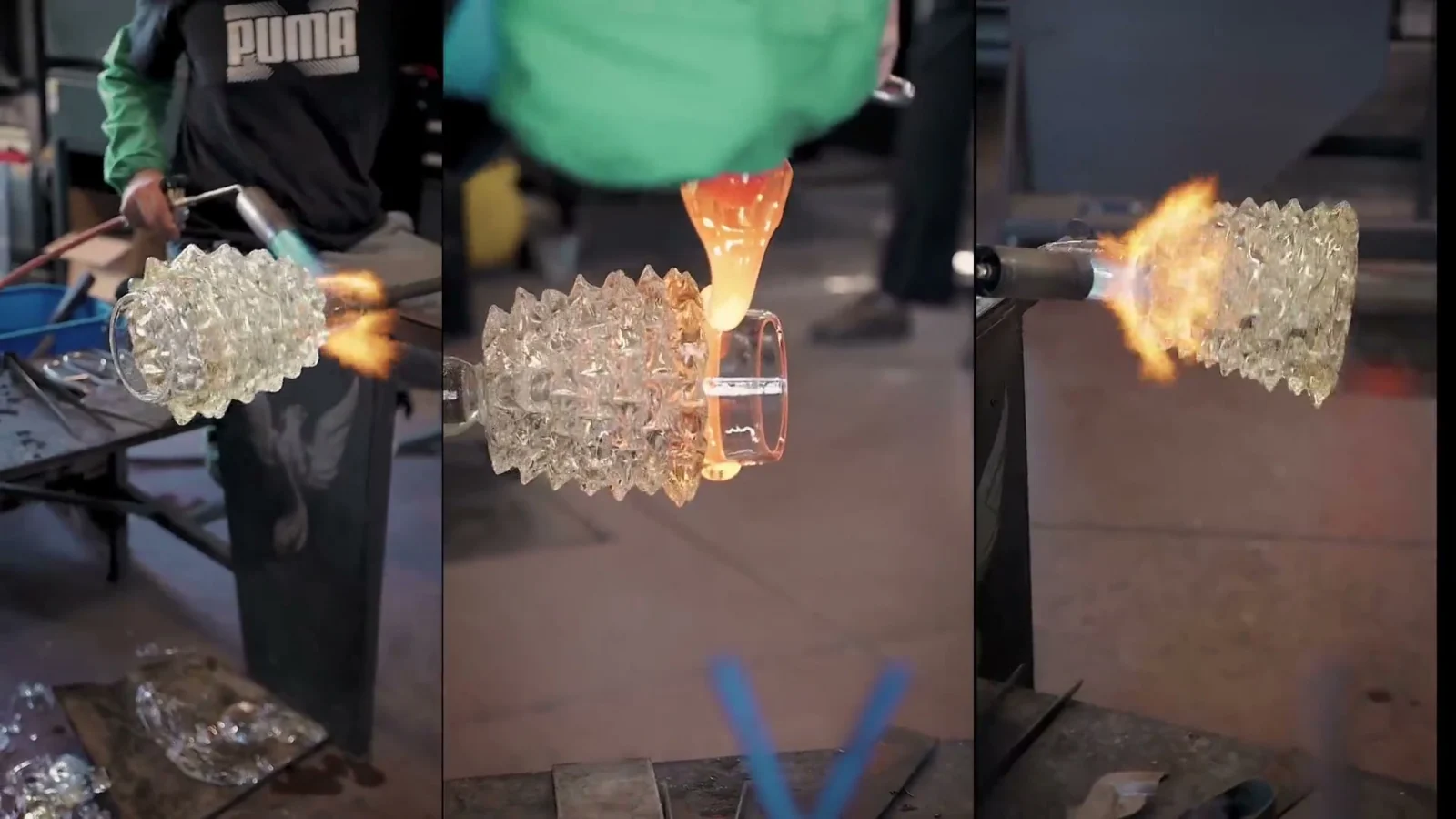
Long before modern factories turned illumination into a disposable commodity, illumination was an intimate dance between flame, breath, and liquid sand. Born on the Venetian island of Murano, glassblowing remains one of the world’s few unbroken artisanal disciplines — and its techniques are the ones we follow in our own workshop in the P.R.C.
The Kiln at 1,400°C: Where Earth Liquefies
The journey of every Murano Lamp begins in the intense heat of the refractory ceramic furnace. Pure silica sand is blended with soda, limestone, and mineral oxides, then melted over twelve continuous hours until it reaches a luminous, honey-like consistency at roughly 1,400°C (2,550°F).
There are no automated thermometers or electronic timers guiding the glassblower. Instead, the glassblower assesses the molten mass through protective amber lenses, gauging viscosity and working temper purely by color—from fiery straw-yellow to deep volcanic cherry.
The Pontil Pipe and the Vital Breath
Working with molten glass is a race against thermodynamic physics. A gather of glowing glass is lifted on the tip of a hollow stainless-steel pontil blowpipe. The Maestro introduces a gentle, calibrated breath into the pipe, creating an internal expansion chamber.
Every contour of a chandelier petal or wall sconce shade is sculpted entirely freehand. Using pear-wood blocks (maveri), iron pincers (borcelle), and shears (tagianti), the artisan turns and pulls the glass on the bench. A few seconds of hesitation, and the glass stiffens beyond manipulation, requiring reheating in the glory hole or returning to the crucible.
Slow Annealing: The Hidden Crucible of Strength
Shaping the glass is only half the alchemy. Once formed, red-hot glass retains profound internal structural stresses. If cooled rapidly at room temperature, it would shatter catastrophically into dust.
Every piece from our atelier is transferred into a specialized annealing lehr (tempera), where it undergoes a controlled cooling cycle over 24 to 48 hours. This glacial temperature descent allows the molecular lattice to relax into absolute mechanical stability, ensuring our chandeliers withstand decades of illumination and seasonal thermal fluctuations.
“In authentic hand-blown glass, no two pieces can ever be identical. When you look up at a hand-blown chandelier, you are looking at the frozen breath and kinetic memory of the craftsman who shaped it.”
The Modern Atelier Vision
At Murano Lamp, we apply these Venetian techniques in our workshop, pairing mouth-blown glass with metal frames and adjustable drop heights to create Murano-style lighting for modern homes.
 Chandeliers
 Ceiling Lights
 Wall Sconces
 Pendant Lights
 Table Lamps